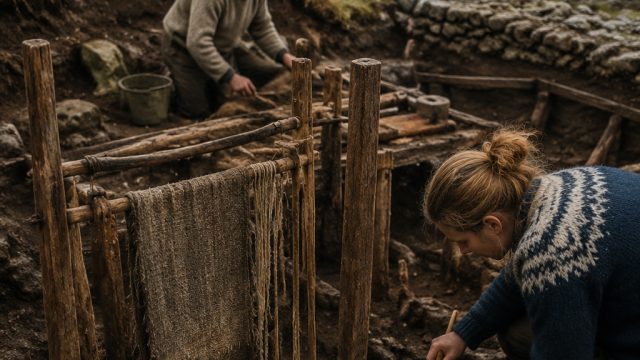
In a remarkable discovery that has captivated historians and archaeologists, a large Viking textile production site has been uncovered in Denmark. This archaeological find not only sheds light on the crafting techniques of the Viking Age but also challenges previous notions of their economic and social structures. As the importance of textiles in Viking society becomes clearer, this discovery invites a re-examination of their daily lives and trade practices.
Unveiling the Site: What Archaeologists Found
Located in the heart of Denmark, the excavation site revealed extensive remnants of textile production, including weaving tools, remnants of fabrics, and evidence of dyeing processes. This find underscores the significant role that textile production played in Viking communities, both as a domestic activity and a potential trade commodity.
Tools and Techniques of the Vikings
The tools discovered at the site—spindles, looms, and dyeing vats—highlight the advanced techniques employed by the Vikings. These artifacts suggest that textile production was not merely a household chore but an intricate craft that required specialized skills. The presence of various dyes also points to a sophisticated approach to coloring fabrics, indicating trade connections with other cultures.
The Significance of Textile Production in Viking Society
The implications of this discovery extend beyond the realm of crafting. Textiles were a cornerstone of Viking economy, and understanding their production can illuminate trade dynamics of the time. As archaeologists analyze the findings, several questions arise about the social hierarchy and economics of the Viking Age:
- Social Structure: How did textile production influence social roles within Viking communities?
- Trade Networks: What trade routes were established based on textile production, and how did they affect local economies?
- Cultural Exchange: In what ways did textiles reflect cultural interactions with neighboring civilizations?
The Role of Textiles in Daily Life
Textiles were not only functional but also carried status and identity. The different types of fabrics and colors could signify various social standings or regional affiliations. By examining textile samples, researchers hope to gather insights into the everyday lives of the Vikings, including their clothing customs and societal values.
Broader Implications of the Discovery
The revelations from this site prompt a reconsideration of Viking history, especially regarding their perceived role as mere raiders or warriors. Instead, this discovery emphasizes their capabilities as skilled artisans and traders. The Vikings' ability to produce and trade textiles suggests a more complex societal structure than previously understood.
Continuing Research and Future Exploration
As the analysis of the site progresses, it is poised to make significant contributions to our understanding of Viking culture. Archaeologists are eager to uncover more details and potentially link this site with other major archaeological finds across Scandinavia.
Conclusion: A New Chapter in Viking Studies
The discovery of this Viking textile production site is not just a significant archaeological find; it is a pivotal moment for historians and enthusiasts of Viking culture. As researchers delve deeper into the artifacts and techniques uncovered at the site, the narrative of Viking life continues to expand, challenging old assumptions and highlighting the sophistication of this remarkable civilization.
For those interested in ancient craftsmanship and the evolution of textile production, this discovery serves as a gateway into a deeper understanding of the Viking Age. Stay tuned for more updates as researchers continue to explore the implications of this groundbreaking find.